Understanding the cancer–immune–microbiome triad
Tumors develop within a dynamic microenvironment shaped by cancer cells themselves, immune and stromal cells, as well as the microbiome. Cancer–immune–microbiome interactions are increasingly recognized as important determinants of cancer development and response to therapy, yet the mechanisms underlying these interactions remain poorly understood.
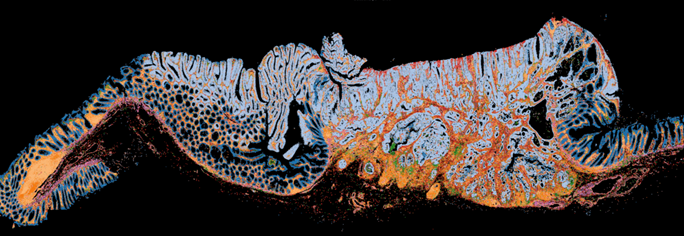
Our Cancer–Immune–Microbiome Group investigates how these interactions emerge and evolve across cancer development, progression and treatment, and how they influence the balance between tumor elimination and progression. One focus is the earliest stages of cancer, when normal, dysplastic and malignant tissues can coexist within the same lesion. These transitional states provide a unique opportunity to understand how the cancer–immune–microbiome ecosystem takes shape and why some lesions progress while others remain indolent.
A complementary focus is understanding how the microbiome can shape anti-tumor immunity and how these interactions can be manipulated to improve immune responses. For example, we investigate how specific gut bacteria and their metabolism of dietary components such as resistant starch may influence antigen-presenting cells within tumors. By linking bacterial composition and function to the tumor immune environment, we aim to uncover how the microbiome can be harnessed to strengthen anti-cancer immunity.
Research focus
Our team aims to:
- Identify how interactions between cancer cells, immune cells and microbes emerge and change during cancer initiation and progression.
- Define how the spatial and cellular context of these interactions influences tumor development and anti-tumor immune responses.
- Determine how specific bacteria and bacterial metabolites modulate anti-tumor immunity, and explore how these interactions can be exploited to improve cancer prevention and treatment.
We combine cutting-edge spatial omics, multi-omics profiling and metagenomic sequencing to dissect the cancer–immune–microbiome ecosystem in unique patient cohorts using valuable patient-derived tissue samples. Our expertise in spatial omics and multi-omics analysis allows us to extract rich molecular, cellular and microbial information from these samples while preserving their spatial and tissue context. By integrating these complementary approaches with functional and experimental models, we aim to uncover the mechanisms that connect cancer cells, immune cells and microbes.
By defining how cancer cells, immune cells and microbes interact across the spatial and molecular landscape of tumor development, we aim to uncover mechanisms that determine whether lesions progress, remain controlled or respond to therapy. Our research will generate mechanistic biomarkers for early disease and patient stratification, while also identifying microbial, immune and molecular pathways that can be targeted to develop new approaches for cancer prevention and treatment.
Key output:
Engels S, Sequeira AM, Ijsselsteijn M, Manzato B, Cardoso S, Dang H, Boonstra JJ, Hawinkels LJAC, Pelka K, Mahfouz A, de Miranda NF, Roelands JP (2024) Deciphering the role of immune cell communities in the initiation and progression of human colorectal cancer. J Immunother Cancer. 12(Suppl 2):A1544.
Roelands J, Kuppen PJK, Ahmed EI, Mall R, Masoodi T, Singh P, Monaco G, Raynaud C, de Miranda NFCC, Ferraro L, Carneiro-Lobo TC, Syed N, Rawat A, Awad A, Decock J, Mifsud W, Miller LD, Sherif S, Mohamed MG, Rinchai D, van den Eynde M, Sayaman RW, Ziv E, Bertucci F, Abdulla Petkar M, Lorenz S, Mathew LS, Wang K, Murugesan S, Chaussabel D, Vahrmeijer AL, Wang E, Fakhro KA, Zoppoli G, Ballestrero A, Tollenaar RAEM, Marincola FM, Galon J, Al Khodor S, Ceccarelli M, Hendrickx W, Bedognetti D (2023) An integrated tumor, immune and microbiome atlas of colon cancer. Nat Med. 29:2379–2392
Roelands J, van der Ploeg M, Ijsselsteijn ME, Dang H, Boonstra JJ, Hardwick JCH, Hawinkels LJAC, Morreau H, de Miranda NFCC (2023) Transcriptomic and immunophenotypic profiling reveals molecular and immunological hallmarks of colorectal cancer tumorigenesis. Gut. 72:1320–1331
Roelands J, Hendrickx W, Zoppoli G, Mall R, Saad M, Halliwill K, Curigliano G, Rinchai D, Decock J, Delogu LG, Turan T, Samayoa J, Chouchane L, Ballestrero A, Wang E, Finetti P, Bertucci F, Miller LD, Galon J, Marincola FM, Kuppen PJK, Ceccarelli M, Bedognetti D (2020) Oncogenic states dictate the prognostic and predictive connotations of intratumoral immune response. J Immunother Cancer. 8